Fifty meters sounds simple on paper. But numbers alone don’t tell your brain much. You need something to picture.
This guide breaks down how long 50 meters really is — in feet, steps, walking time, and everyday objects you already know. No fluff, just clear facts you can actually use.
Table of Contents
How Long Is 50 Meters? Quick Answer
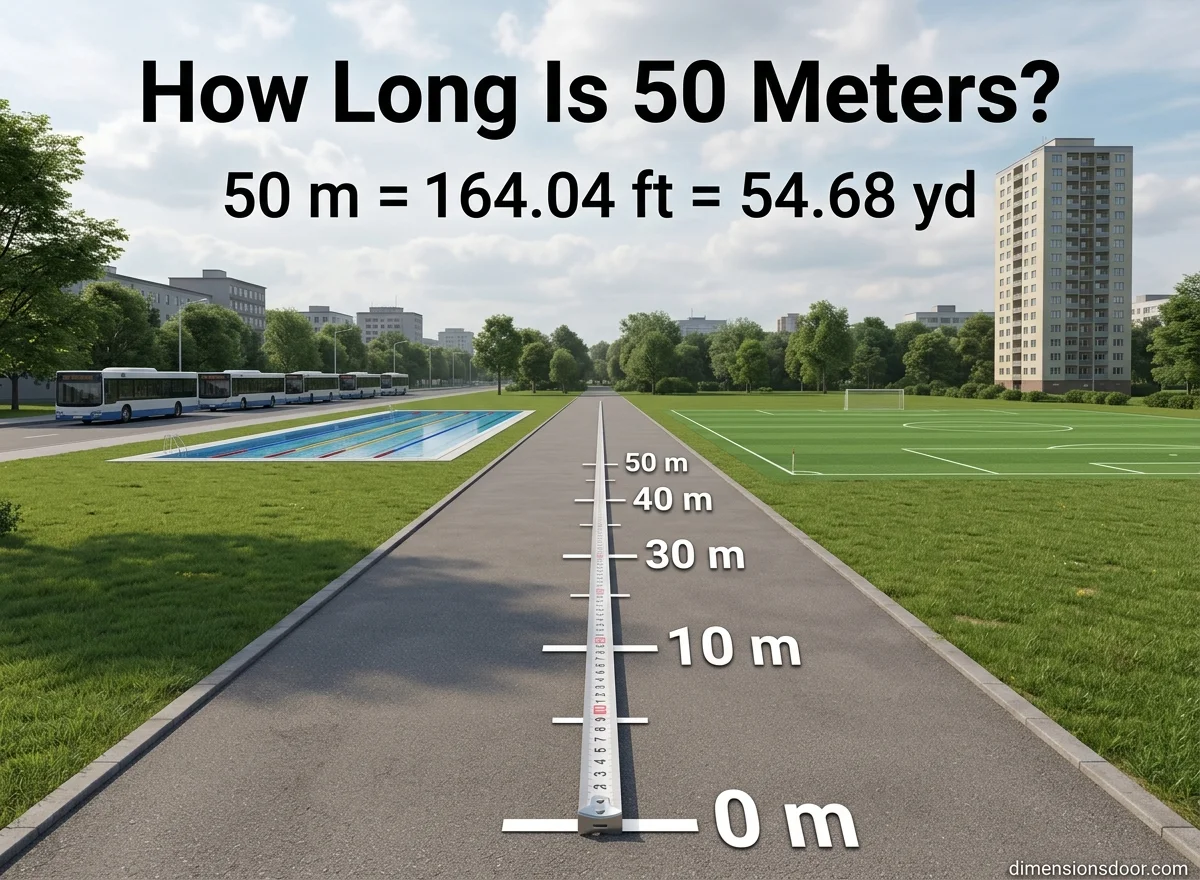
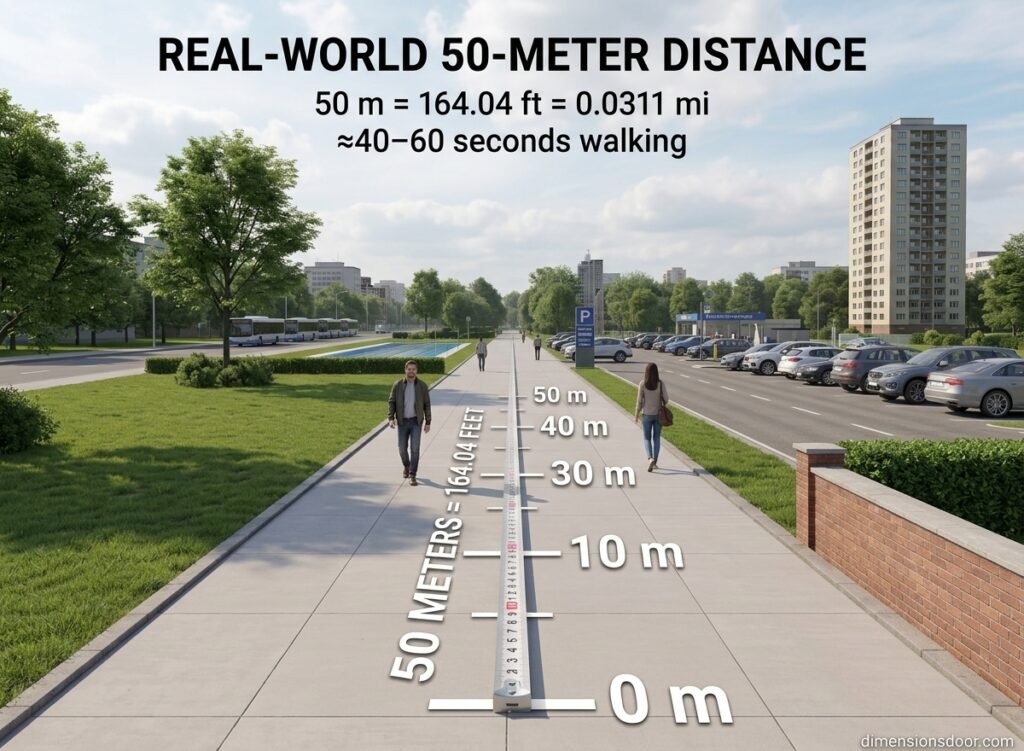
50 meters equals 164.04 feet. That’s also 54.68 yards, 1,968.5 inches, or 0.031 miles.
Here’s the full breakdown in one place:
| Unit | Value |
|---|---|
| Feet | 164.04 ft |
| Yards | 54.68 yd |
| Inches | 1,968.5 in |
| Centimeters | 5,000 cm |
| Miles | 0.0311 mi |
How Big Is 50 Meters in Feet?
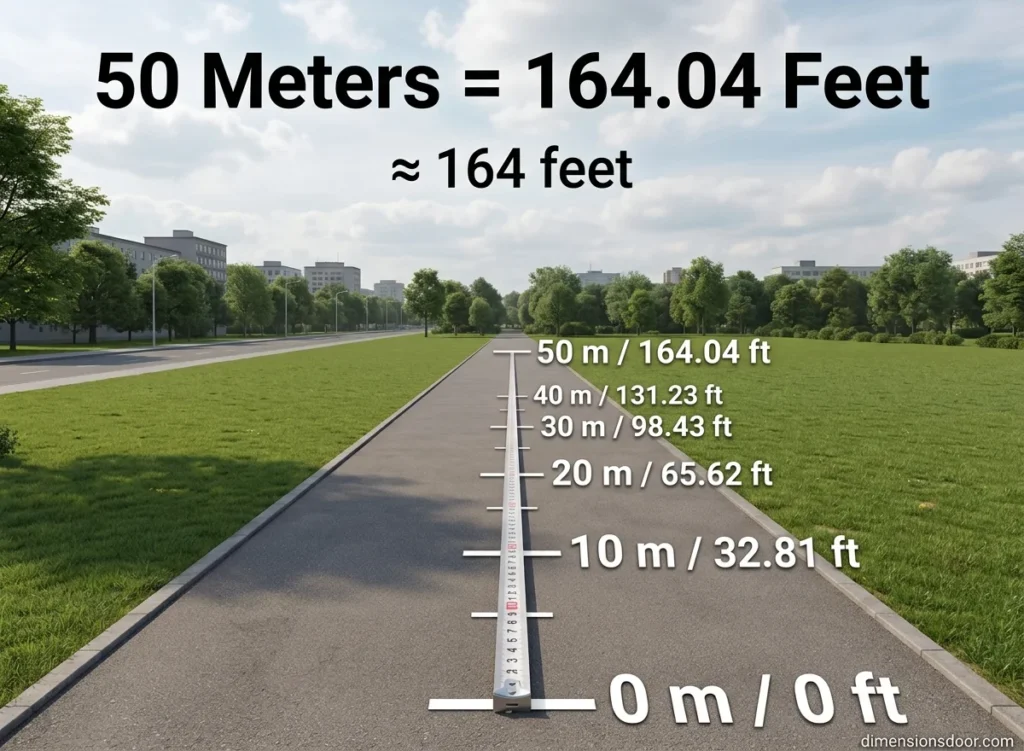
50 meters in feet comes out to 164.04 feet. The math is simple: one meter equals 3.28084 feet, so multiplying 50 by 3.28084 gives you the exact figure. This conversion rate comes straight from the International System of Units (SI), the global standard for measurement.
For quick mental math, round it to 164 feet. That’s close enough for almost any real-world use — construction, sports, or just picturing distance in your head.
How Long Is 50 Meters Visually? (Visual Guide)
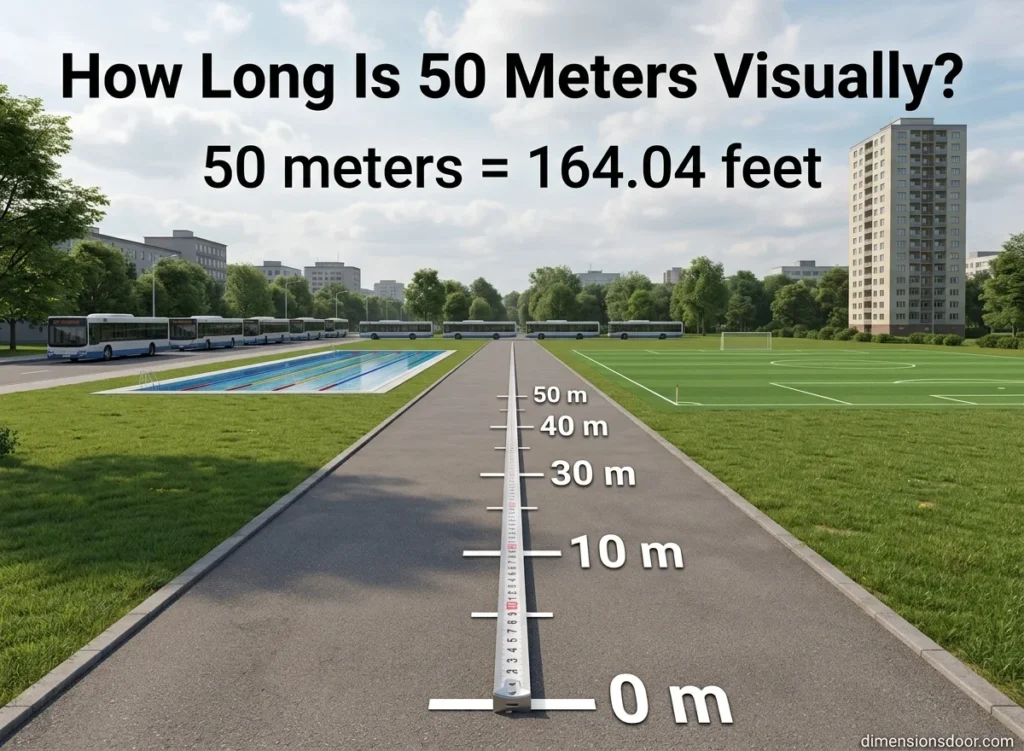
Numbers don’t stick. Pictures do. Here’s how to visualize 50 meters using things your eyes already know.
Think of an Olympic swimming pool.
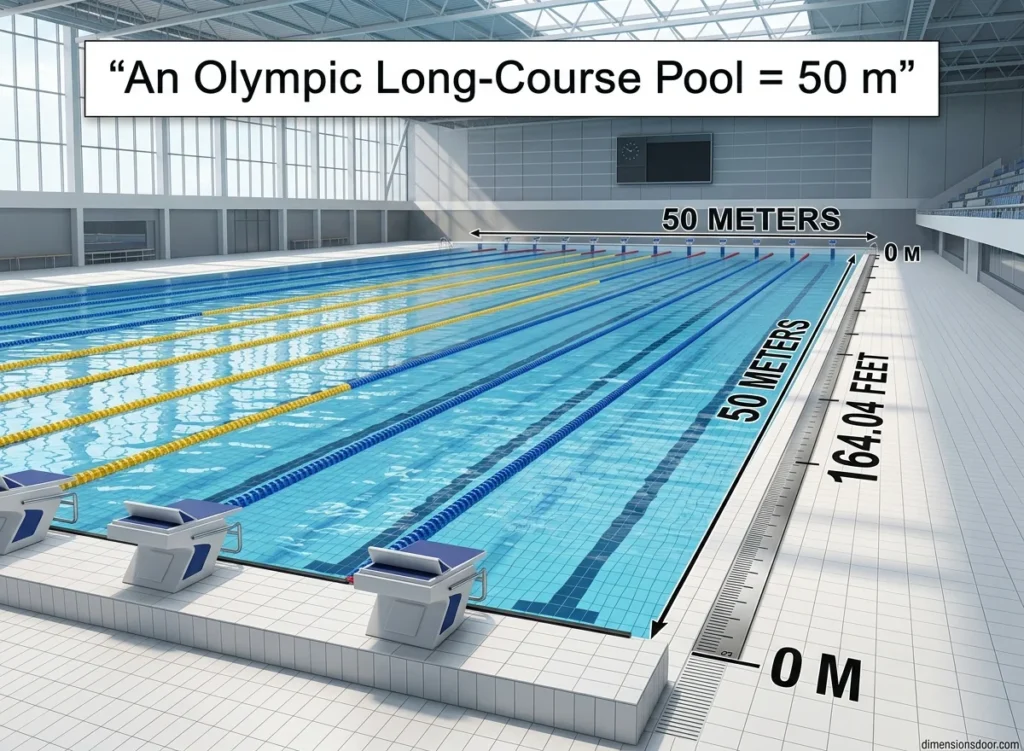
A regulation long-course pool measures exactly 50 meters, according to World Aquatics rules. Swimmers racing the 50-meter freestyle cover this entire length in one straight sprint — no turns, no walls, just a flat-out dash from one end to the other.
Now picture a 16-story building lying on its side.
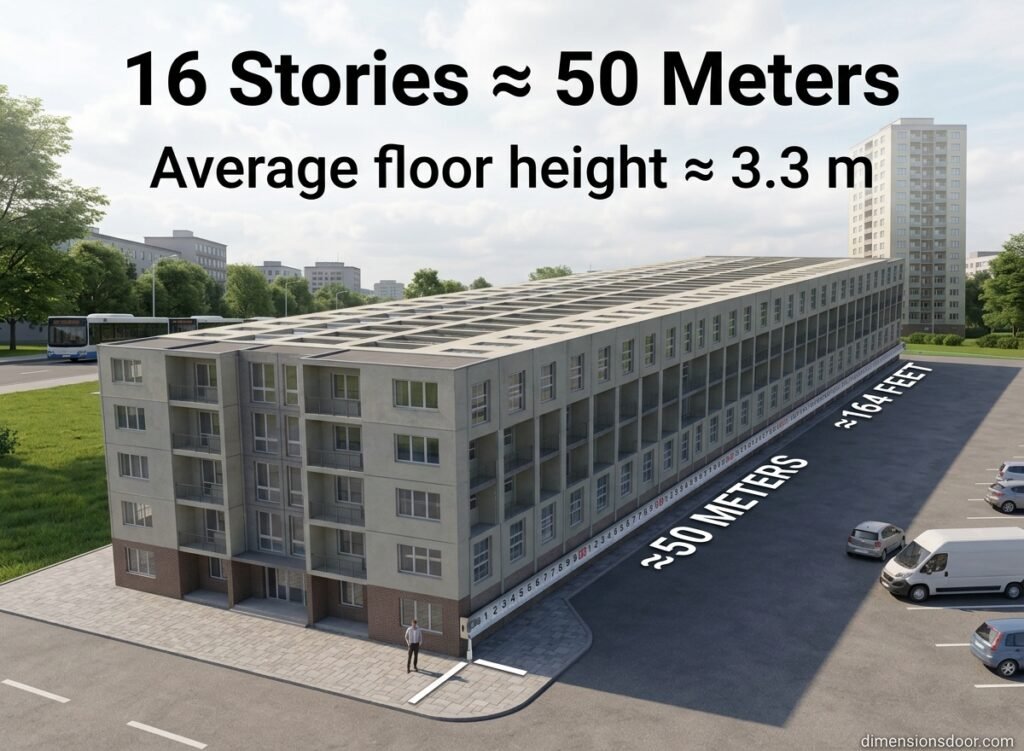
With an average floor height near 3.3 meters, stacking 15 to 16 floors gets you close to 50 meters. Turn that height sideways, and you’ve got your distance.
A soccer field cut in half works too. FIFA sets the minimum pitch length at 100 meters under the official Laws of the Game. Split that field down the middle, and each half lands almost exactly at 50 meters.
Five city buses parked end to end also gets you there. A standard transit bus runs about 40 feet, so five of them bumper-to-bumper stretch close to the full 164-foot mark.
How Long Is 50 Meters to Walk? (Steps, Time & Miles)
This is where most conversion guides stop short. Walking distance matters just as much as raw measurement — especially if you’re planning a route, a workout, or just trying to gauge how far something really is.
How Long Is 50 Meters in Steps?
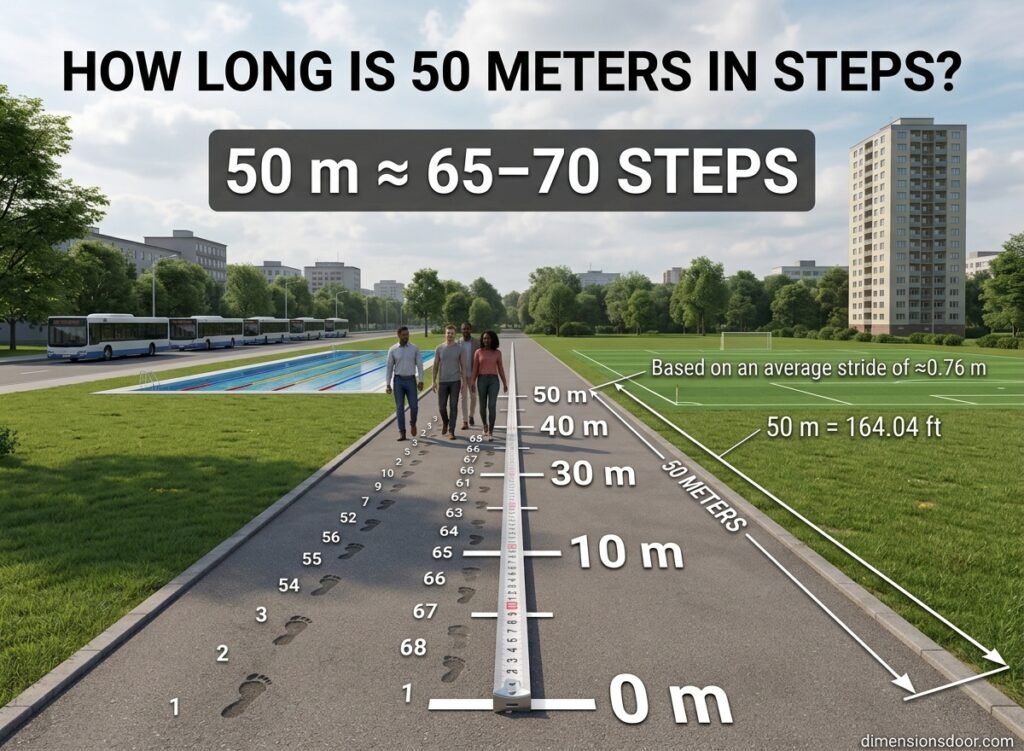
The average adult stride measures roughly 0.76 meters (about 2.5 feet). Using that number, walking 50 meters takes somewhere between 65 and 70 steps. Taller people with longer legs might cover it in fewer steps, closer to 60. Shorter strides could push that number past 70.
How Far Is 50 Meters in Miles to Walk?
50 meters equals just 0.031 miles. That’s a fraction of a mile — not even close to a full block in most American cities. For context, a typical U.S. city block runs around 100 to 130 meters, so 50 meters covers less than half of one block.
Walking Time for 50 Meters
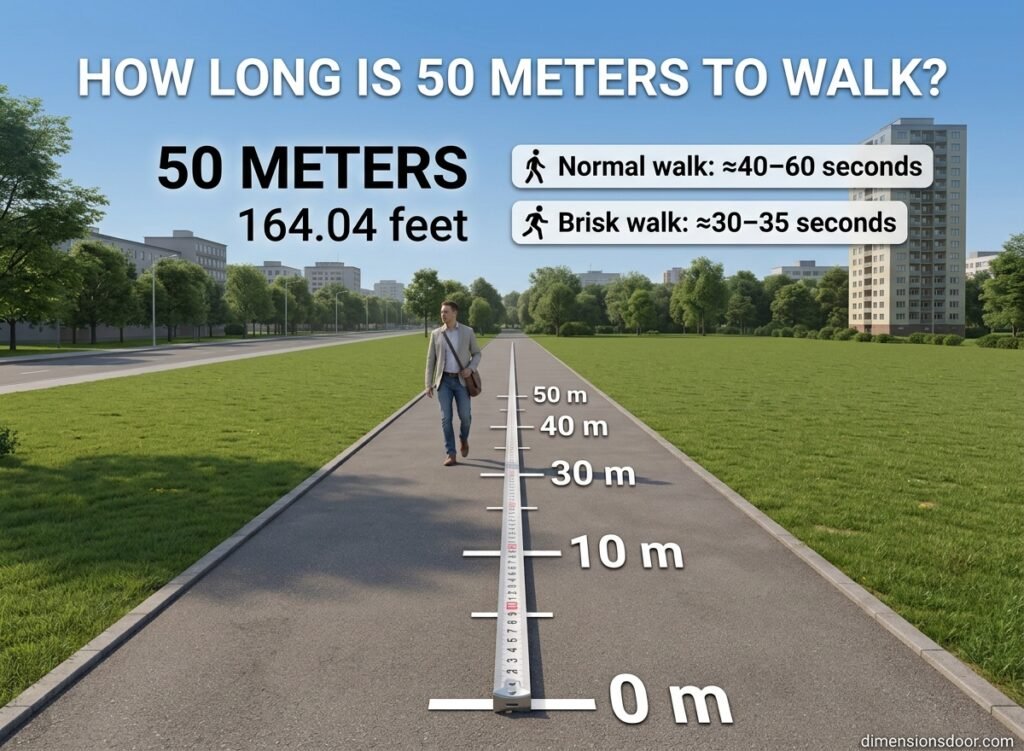
At a relaxed pace, most people cover 50 meters in about 45 to 60 seconds. Pick up the pace to a brisk walk, and that drops to roughly 35 to 40 seconds. Joggers can clear it in under 15 seconds without much effort.
| Pace | Time to Cover 50 Meters |
|---|---|
| Slow walk | 55–60 seconds |
| Average walk | 40–50 seconds |
| Brisk walk | 30–35 seconds |
| Light jog | 15–20 seconds |
How Far Is 50 Meters? 15 Real-Life Examples & Comparisons
Here’s where 50 meters gets easy to grasp — through things you’d actually run into during a normal week.
Sports and recreation:
- Olympic swimming pool — exactly 50 meters, the international standard for long-course competition.
- Half a soccer field — FIFA’s regulation pitch runs 100 meters minimum, so 50 meters is the halfway line.
- Two and a half cricket pitches — each pitch measures 20.12 meters between the bowling creases.
- Two tennis courts — a single court runs about 23.77 meters long, so two placed together get close to 50 meters.
- 1.75 NBA basketball courts — a regulation court measures 28.65 meters end to end.
Everyday objects and structures: 6. Five city buses — parked end to end, standard transit buses reach this mark. 7. Almost five telephone poles — stacked lengthwise, typical utility poles get you most of the way there. 8. Two semi-truck trailers — a standard trailer runs about 16 meters, so roughly three in a row would slightly exceed 50 meters. 9. A 16-story building — turned on its side, using an average 3.3-meter floor height. 10. Half a Manhattan city block — long blocks in NYC’s grid stretch close to 100 meters north to south.
Nature and landmarks: 11. A mature giant sequoia tree — some reach heights close to 50 meters, rivaling that same 16-story building. 12. Nearly two blue whales — the largest animal on Earth reaches up to 30 meters, so two nose-to-tail come close to matching this distance. 13. The Leaning Tower of Pisa — standing 55.86 to 56.67 meters depending on which side you measure, it’s just past the 50-meter mark. 14. The Statue of Liberty — measuring about 46 meters from heel to torch, according to the National Park Service, it falls just short of 50 meters. 15. A commercial airplane’s wingspan — many mid-size jets, like the Boeing 767, have wingspans near 50 meters.
Must Visit: How Long Is 2 Meters? 15 Real-Life Examples, Comparisons & Visual Guide
How Far Is 50 Meters Example? (Practical, Real-World Context)
Beyond comparisons, 50 meters shows up constantly in rules, regulations, and daily decisions.
In competitive sports, the 50-meter freestyle is one of swimming’s fastest Olympic events — elite swimmers finish it in around 21 to 24 seconds. On a track, 50 meters isn’t an official race distance, but it’s roughly half of the 100-meter dash, a common marker coaches use for speed drills.
In daily life, 50 meters is also a practical safety reference. Many consumer drones have a recommended visual-line-of-sight range starting around this distance. Some public health guidance during outdoor events has used similar figures for spacing large crowds. Standard retractable dog leashes rarely exceed 8 meters, so 50 meters is more than six times that length — useful context if you’re picturing open-field distance versus a walk around the block.
In construction and real estate, 50 meters often marks property boundaries, setback requirements, or the length of a mid-size parking lot. It’s a distance small enough to walk casually, yet large enough to matter when planning space.
FAQS
How long is 50 metres to walk?
Walking 50 meters takes about 40 to 60 seconds at a normal pace, depending on stride length and walking speed.
How big is 50 meters in feet
? 50 meters equals 164.04 feet, or roughly 164 feet when rounded.
How far is 50 meters in miles to walk?
50 meters is equal to 0.031 miles — a small fraction of a single mile.
How long is 50 meters in steps?
Most adults need about 65 to 70 steps to cover 50 meters, based on an average stride of 0.76 meters.
Conclusion
50 meters equals 164 feet, 54.68 yards, and about 0.031 miles. It’s the length of an Olympic pool, half a soccer field, or roughly a minute’s walk for most people.
Once you connect the number to something familiar — a pool, a building, a field — the distance stops feeling abstract. That’s really all measurement comparisons are for: turning numbers into something you can actually picture.

William Ahad is the founder and lead writer at DimensionsDoor, where he researches and publishes verified measurement guides covering doors, furniture, appliances, and everyday objects. With a background in home improvement and product research, William has spent years cross-checking manufacturer specifications, industry standards, and real-world listings to help readers get accurate dimensions before they buy, build, or install anything.