How long is 100 feet? A permit says “maximum height: 100 feet.” A property survey lists a “100-foot setback.” A court order names a “100-foot distance.” None of that means much until you can see it.
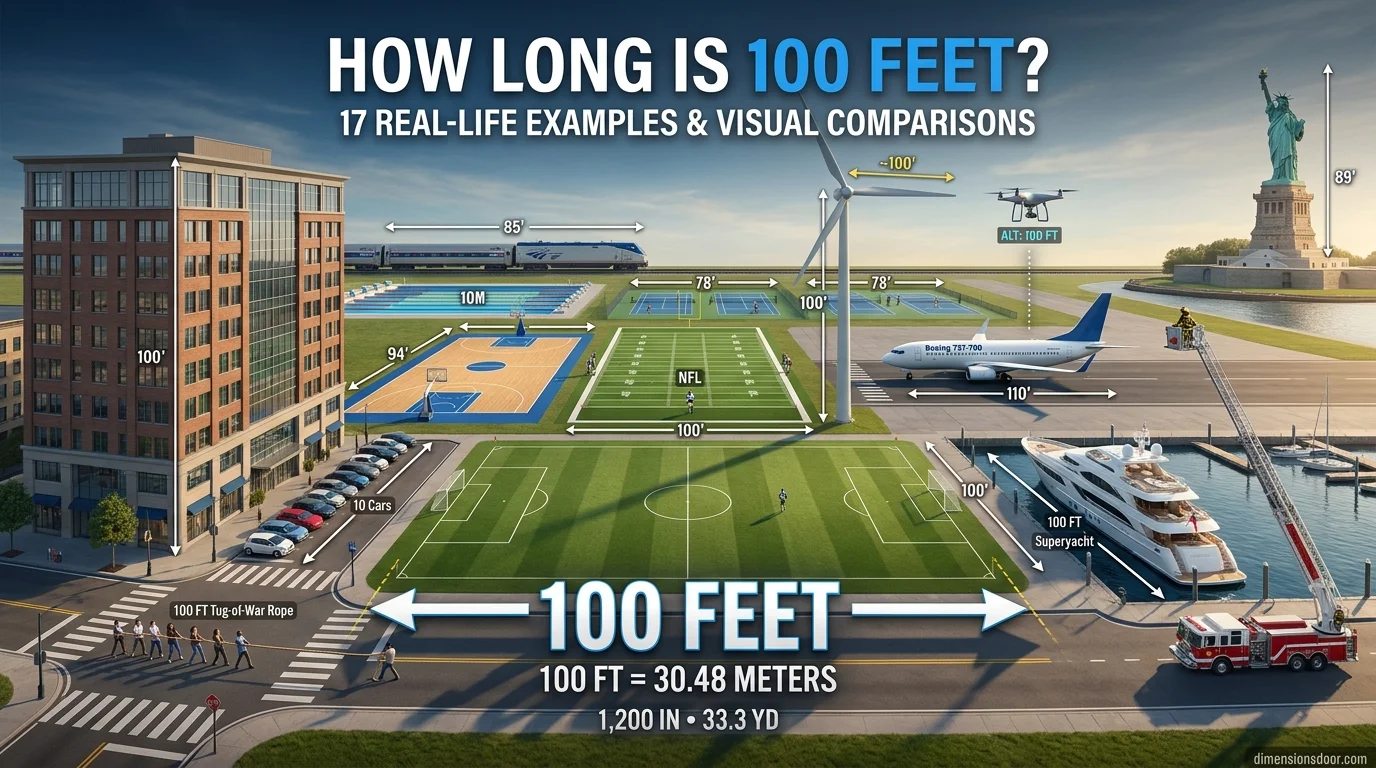
100 feet equals 1,200 inches, 33.3 yards, or 30.48 meters. That’s roughly the height of a 10-story building, or the length of a Boeing 737’s fuselage. This guide turns that number into something you can actually picture — using 17 real objects, a football field comparison, and simple ways to measure it yourself.
Table of Contents
How Long Is 100 Feet? Quick Conversion Chart
Here’s the direct answer first.
100 feet = 30.48 meters. To convert feet to meters, multiply by 0.3048. It’s a fixed, exact conversion — not an estimate — because the U.S. foot has been legally tied to the meter since 1959.
| Unit | Value |
|---|---|
| Inches | 1,200 in |
| Feet | 100 ft |
| Yards | 33.3 yd |
| Meters | 30.48 m |
| Centimeters | 3,048 cm |
| Kilometers | 0.03 km |
| Miles | 0.019 mi |
The foot is still the default unit for everyday American life — home listings, road signs, ladder lengths, and building codes all run on feet. Most of the rest of the world uses meters instead, which is why both numbers matter if you’re reading international specs, importing equipment, or just curious how the two systems line up.
Use our Feet to Inches Converter Tool to quickly and accurately convert any measurement in feet into inches, making length calculations simple and hassle-free.
17 Real-Life Things That Are 100 Feet Long
Numbers alone don’t stick. Objects do. Below are 17 things that sit at or near the 100-foot mark, each explained on its own so you can see exactly why it measures the way it does.
A 10-story building

Architects plan for roughly 10 feet per floor, which covers ceiling height plus the slab, wiring, and ductwork packed between levels. Ten floors stacked up lands almost exactly at 100 feet. This is also why many U.S. mid-rise zoning codes cap new construction at this height — go taller, and stricter fire-safety and structural rules kick in. Next time you pass a 10-story apartment building, you’re looking straight up at 100 feet.
A Boeing 737-700’s fuselage
At roughly 110 feet nose to tail, this is the closest common commercial aircraft to our benchmark. That length isn’t arbitrary — it had to fit around 140 passengers in a 3-and-3 seating layout while still clearing standard airport gates and tight tarmac turns. Walk from the front galley to the rear lavatory on one of these planes and you’ve covered close to 100 feet without ever noticing.
An NBA basketball court
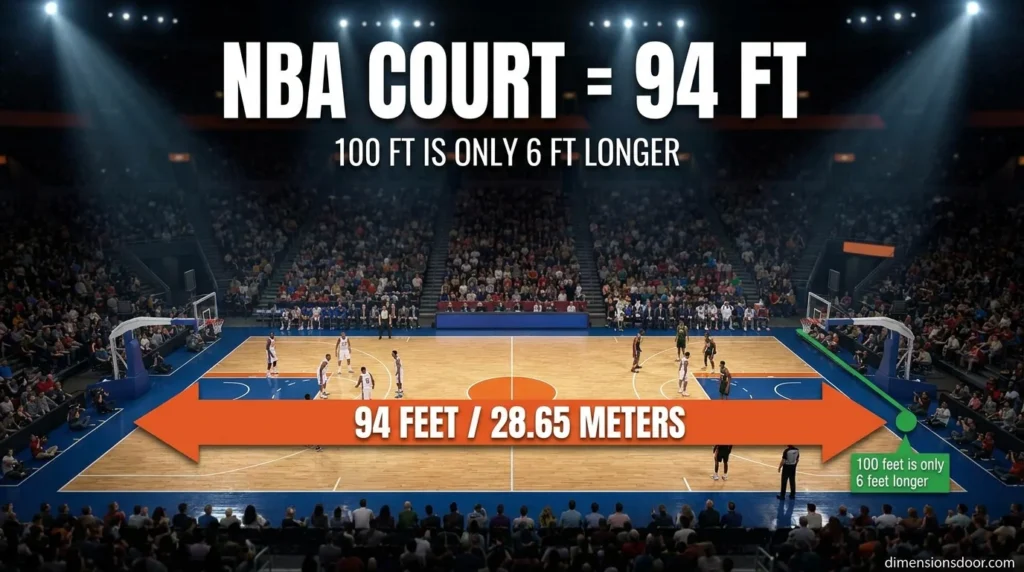
A regulation court runs 94 feet baseline to baseline — just shy of 100 feet, and one of the most familiar size references in the country. The dimension dates back to early-1900s gymnasiums, sized to fit inside existing building walls while still allowing a fast-paced game. Anyone who’s run a full-court sprint in gym class has already felt this distance in their legs.
A fire department’s aerial ladder
Fully extended, a standard truck-mounted ladder reaches exactly 100 feet under NFPA safety standards — no rounding needed. That length is engineered on purpose: positioned at the curb, it can reach the roof or top window of a 10-story building, tying directly back to the first example on this list. It’s one of the few places where “100 feet” isn’t an approximation but an exact, regulated number.
A 100-foot superyacht
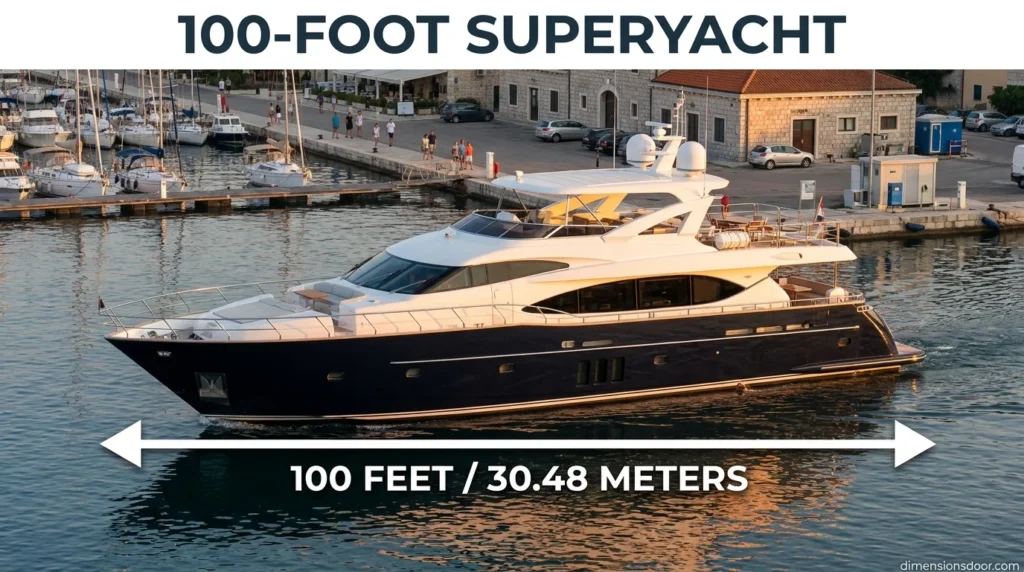
In maritime law, 100 feet is the precise line where a private boat is legally reclassified as a superyacht. Cross that threshold and the vessel can no longer be owner-operated — it now needs a licensed captain, upgraded safety equipment, and different docking permits. A boat that looks about the length of a tennis court and a half, docked at a marina, is usually sitting right at or near this mark.
The Statue of Liberty, base to crown
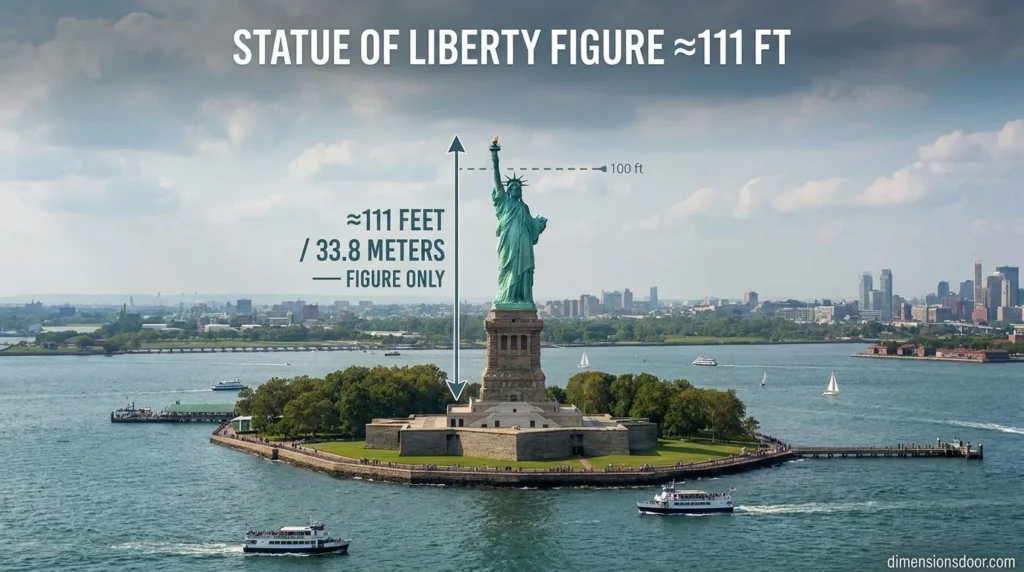
Measuring the figure alone, without the pedestal, she stands about 111 feet tall — taller than most people guess from photos. Sculptor Frédéric Bartholdi designed her to be visible from ships entering New York Harbor, which meant building tall while staying within what the internal iron framework could structurally support. That’s roughly the height of an 11-story building rising above the harbor.
A small commercial wind turbine tower
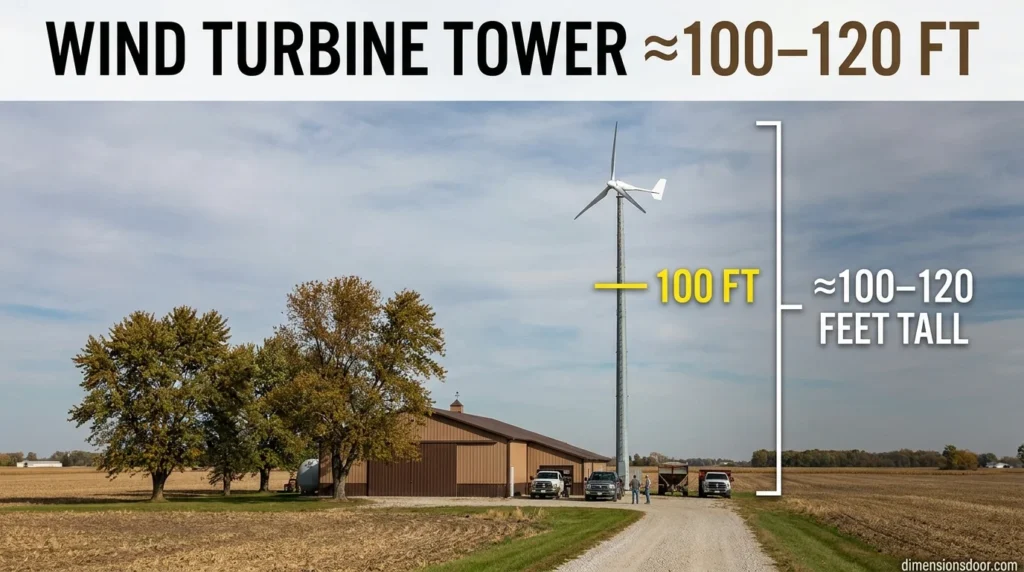
These towers, common on farms and small businesses, typically stand between 100 and 120 feet tall. That height is a calculated compromise: tall enough to place the blades above tree-level turbulence where wind blows steadier, but short enough to stay under the FAA’s 200-foot threshold, which would otherwise trigger lighting and marking requirements.
A regulation tug-of-war rope
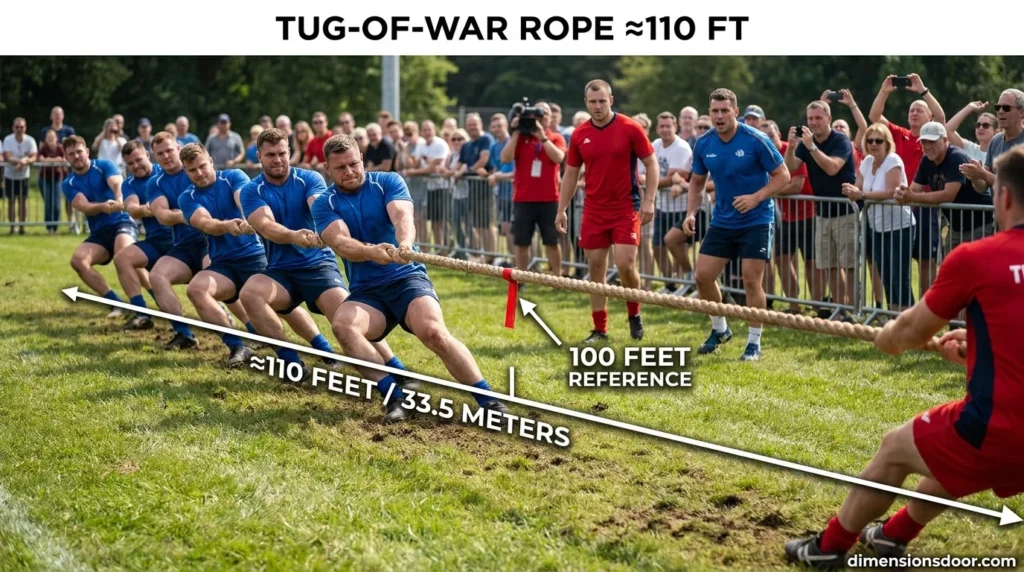
Set by the Tug of War International Federation, competition rope runs about 110 feet long. That length gives two eight-person teams enough space to grip safely on either side of the center mark, plus extra tail rope at each end to prevent injury. The red center ribbon — the point that decides the match — sits 55 feet from each team, just over half our 100-foot benchmark.
A standard Amtrak passenger car
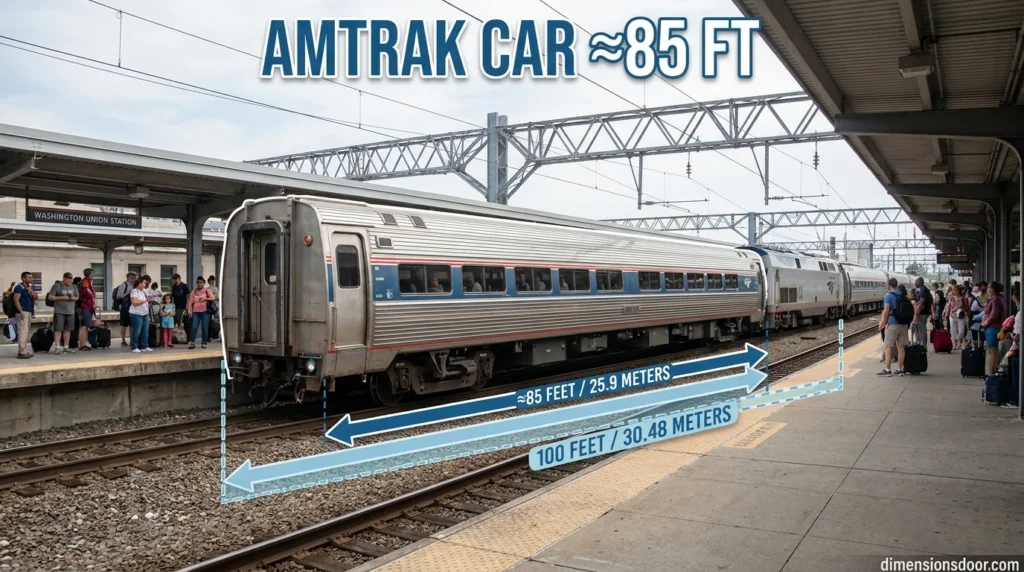
A single car measures around 85 feet, a length shaped by decades-old tunnel clearances and curved track sections built long before modern rail engineering. Inside that space: 60 to 80 seats, a restroom, and luggage storage. Six cars parked end to end already stretch past 500 feet, which explains why waiting at a crossing for a 12-car train can feel endless.
An Olympic pool’s width
Most people picture the 164-foot length, but the width — sized to hold 10 racing lanes at 2.5 meters each — comes in at about 82 feet. That’s the dimension that actually sits closest to our 100-foot mark, and it’s a detail most size comparisons overlook entirely.
One end zone to the 33-yard line on an NFL field
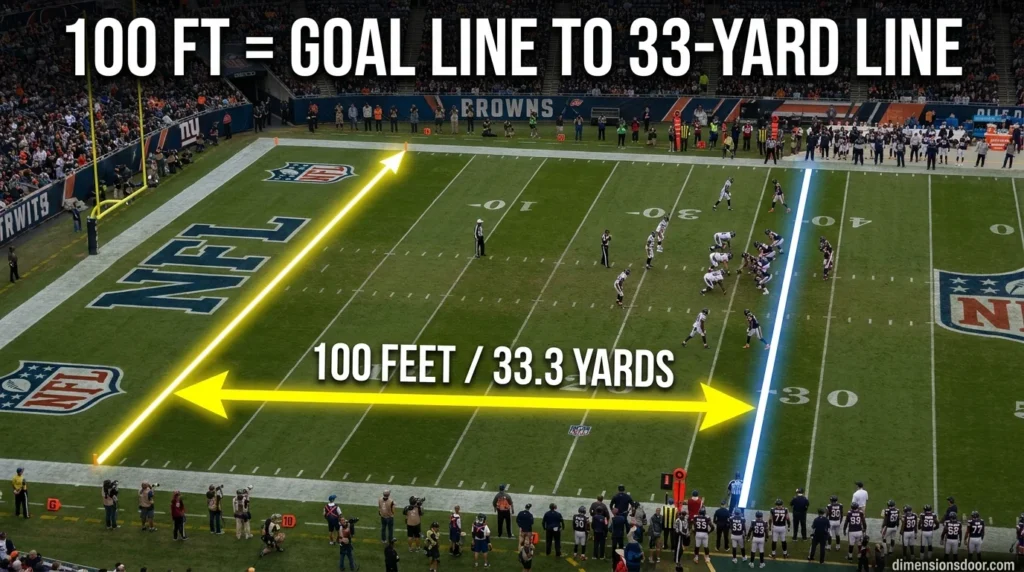
Rather than picturing the whole field, this gives a sport-specific way to visualize exactly 100 feet using a single, familiar landmark: the goal line to roughly a third of the way downfield.
A standard U.S. city block segment
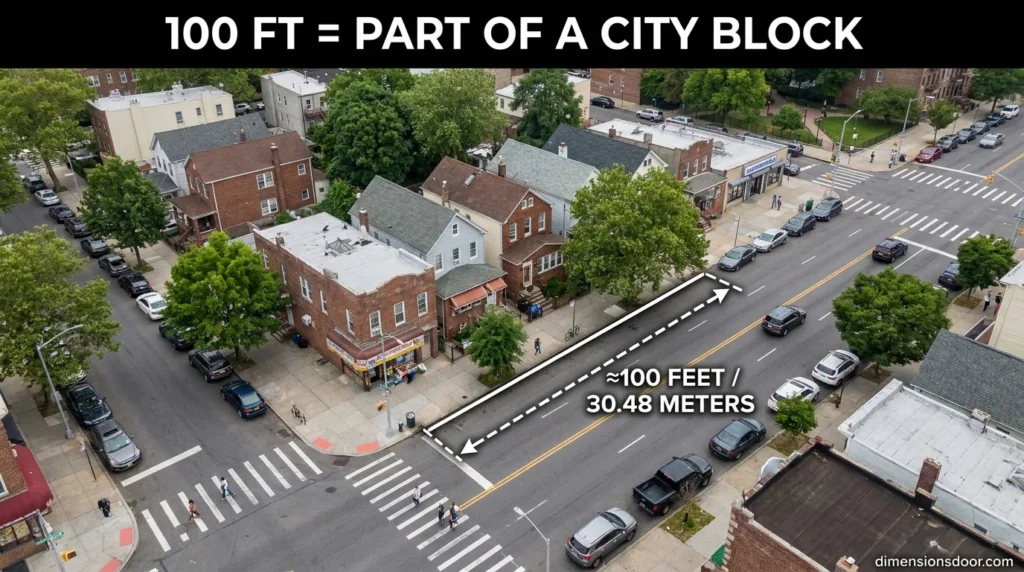
Gridded American cities like Portland and Salt Lake City typically use blocks in the 200 to 300-foot range. That means 100 feet covers roughly a third to half of one typical block face — useful the next time you’re estimating walking distance between intersections.
A soccer pitch’s width
At the narrower end of FIFA’s allowed range (about 165 to 225 feet). A hundred feet marks less than half that width, which helps clear up a common mix-up between a pitch’s length and its width.
Three tennis courts laid end to end
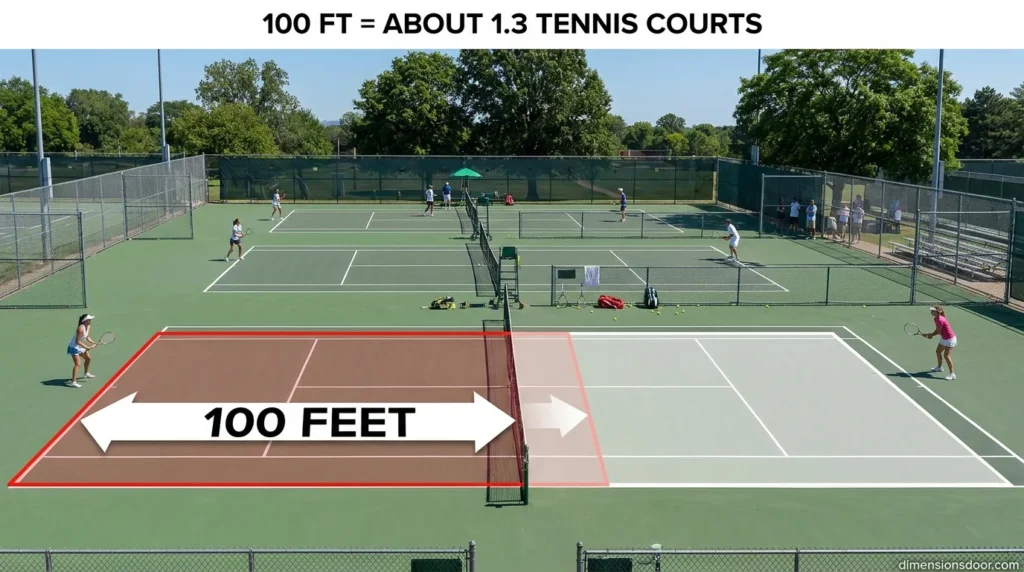
Each court measures about 78 feet long, so three in a row stretches to roughly 234 feet — meaning 100 feet actually covers a bit more than one full court length plus some overrun. It’s a helpful anchor for anyone picturing distance across a park or recreation complex.
A four-lane U.S. road, including shoulders and median
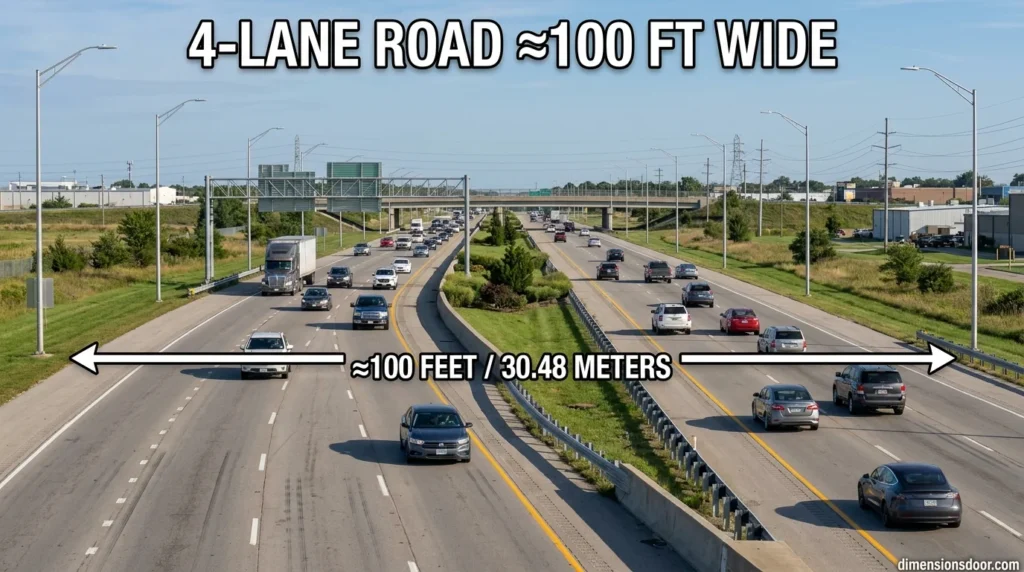
Traffic engineers frequently design major arterial roads to this exact width, balancing lane count, shoulder space, and a center divider for safety. Standing on one curb and looking across to the other gives a real, ground-level sense of 100 feet.
Ten compact cars parked bumper to bumper
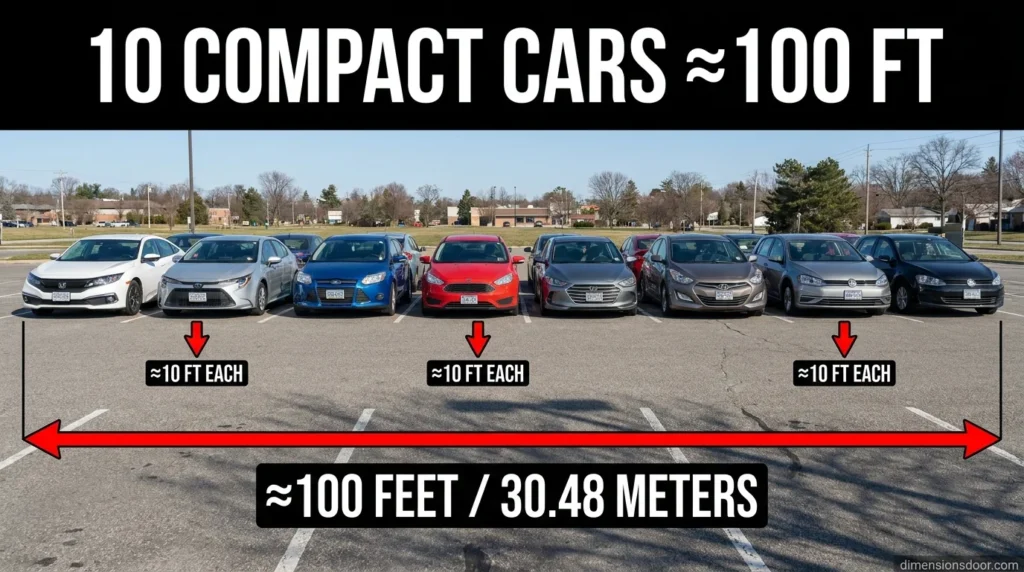
At roughly 10 feet per car, this is one of the fastest mental-math tricks for the distance. Picture a full row of parked cars along a curb, and you’re looking at almost exactly 100 feet of pavement.
The FAA’s drone altitude reference
The FAA caps recreational drone flights at 400 feet, but many local ordinances and hobbyist safety guides break that ceiling into 100-foot bands when explaining safe distances from people, buildings, and airports. It’s a detail almost never covered in general size-comparison content, despite being directly useful to the growing number of U.S. drone hobbyists.
Must Visit: How Long Is 50 Feet? 15 Real-Life Examples, Comparisons & Visual Guide
| Object | Approximate Size | Type |
|---|---|---|
| 10-Story Building | 100 ft | Height |
| Boeing 737-700 | ~110 ft | Length |
| NBA Basketball Court | 94 ft | Length |
| Fire Aerial Ladder | 100 ft | Length |
| Superyacht Threshold | 100 ft | Length |
| Statue of Liberty (figure) | ~111 ft | Height |
| Wind Turbine Tower | 100–120 ft | Height |
| Tug-of-War Rope | ~110 ft | Length |
| Amtrak Passenger Car | ~85 ft | Length |
| Olympic Pool (width) | ~82 ft | Width |
| NFL Field Segment | 100 ft | Length |
| City Block Segment | ~100 ft | Length |
| Soccer Pitch (width) | 165–225 ft | Width |
| Three Tennis Courts | ~234 ft | Length |
| Four-Lane Road | ~100 ft | Width |
| Ten Compact Cars | ~100 ft | Length |
| FAA Drone Altitude Band | 100 ft increments | Height |
How to Measure or Estimate 100 Feet
You don’t need a construction crew to figure this out. Here’s how professionals and everyday people do it.
Use a measuring wheel
Contractors and surveyors roll these along the ground for a fast, accurate readout — the go-to tool for anything longer than a standard tape measure.
Use a laser distance meter
Point it, click, done. Most models are accurate within a fraction of an inch and handle distances well beyond 100 feet instantly.
Try a smartphone AR measuring app
Newer phones with LiDAR sensors, like recent iPhone Pro models, can measure real-world distances through the camera — surprisingly close to laser-tool accuracy for quick estimates.
Unroll a garden hose
A standard U.S. garden hose is sold in 50 or 100-foot lengths. Stretch one across your yard and you have an exact reference line, no tools required.
Count your steps
An average adult stride covers about 2.5 feet. Walk 40 normal steps in a straight line and you’ve covered roughly 100 feet.
Time yourself walking it.
| Walking Speed | Feet per Second | Time to Cover 100 Feet |
|---|---|---|
| Slow (2 mph) | 2.9 ft/s | ~34 seconds |
| Average (3 mph) | 4.4 ft/s | ~23 seconds |
| Brisk (3.5 mph) | 5.1 ft/s | ~20 seconds |
| Fast (4 mph) | 5.9 ft/s | ~17 seconds |
How long is 100 feet to walk? At a normal pace, most adults cover it in 15 to 23 seconds — barely longer than it takes to read this paragraph out loud.
100 Feet Compared to a Football Field and Other Distances
How long is 100 feet compared to a football field? A full U.S. football field, end zones included, measures 360 feet. Without end zones, the playing field alone is 300 feet. Either way, 100 feet covers about one-third of the field — roughly the distance from one goal line to the 33-yard line.
| Distance | In Meters | Compared to 100 Feet |
|---|---|---|
| 50 feet | 15.24 m | Half the length |
| 75 feet | 22.86 m | Three-quarters |
| 100 feet | 30.48 m | Reference point |
| 150 feet | 45.72 m | 1.5× longer |
| 200 feet | 60.96 m | Double |
| 300 feet | 91.44 m | Full football field (no end zones) |
Is 100 feet a long distance? It depends entirely on context. Indoors, it’s enormous — most American living rooms are under 20 feet across, so 100 feet would span five rooms in a row. Outdoors, it’s modest: a short sprint, a small backyard, or a fraction of a city block. On the road or in the sky, it barely registers — a car traveling 60 mph covers 100 feet in about one second.
Why 100 Feet Matters in Everyday U.S. Life
This measurement shows up in more official contexts than most people realize.
Property and zoning. Many U.S. municipalities require a setback distance — the gap between a building and the property line — and 100 feet is a common threshold for rural or agricultural zoning, wells, and septic systems.
Real estate listings. Lot depth is often measured in feet, and a “100-foot lot” is a standard, easily searchable size in suburban and rural listings across the country.
Fire safety codes. As covered above, the 100-foot aerial ladder is a national firefighting standard, directly tied to the height limits of mid-rise construction.
Drone and aviation rules. While the FAA’s hard ceiling for recreational drones is 400 feet, many local safety guidelines reference 100-foot bands when advising hobbyists on safe distances from people, buildings, and airports.
Personal safety and legal distance. Some U.S. protective orders and workplace safety guidelines specify minimum distances in the 100-foot range — another reason this number turns up in searches beyond simple curiosity.
FAQs
How long is 100 feet visually?
Picture a 10-story building standing on its end, or a Boeing 737’s fuselage laid flat on a runway. Both are almost exactly 100 feet, making them reliable mental anchors.
How long is 100 feet compared to a football field?
It’s about one-third of a full football field (300 feet without end zones, 360 feet with them) — roughly the distance from the goal line to the 33-yard line.
What do 100 feet look like?
Close to the length of an NBA basketball court (94 feet), or ten compact cars parked bumper to bumper. Both give a fast, familiar visual.
How long is 100 feet to walk?
About 15 to 23 seconds at a normal walking pace, or roughly 40 average steps.
What objects are 100 feet long?
A fire department’s fully extended aerial ladder, a 100-foot superyacht, a small wind turbine tower, and a regulation tug-of-war rope all sit right at or near 100 feet.
Is 100 feet a long distance?
It’s long indoors and short outdoors. Compared to a room, it’s huge. Compared to a football field or a highway mile, it’s a small slice.
Conclusion
A number like “100 feet” only means something once it’s tied to something real. Whether it’s a fire ladder reaching a rooftop, a football field’s one-third mark, or 40 steps across a parking lot, these references turn an abstract measurement into something you can picture instantly — and use with confidence the next time it comes up.

William Ahad is the founder and lead writer at DimensionsDoor, where he researches and publishes verified measurement guides covering doors, furniture, appliances, and everyday objects. With a background in home improvement and product research, William has spent years cross-checking manufacturer specifications, industry standards, and real-world listings to help readers get accurate dimensions before they buy, build, or install anything.